
Control IP · Power Electronics
Converter-Level Autonomy
QuietEdge moves fast observation, coordination and bounded response into the power-conversion layer, close to the electrical event, while higher-level systems retain awareness and policy.
Local response. Global awareness.
System Timescales
Every layer responds on a different clock
Different parts of the power system operate on fundamentally different timescales. The fastest event should be stabilized by the nearest capable layer — not by waiting for a round-trip to a system that operates orders of magnitude slower.
The fastest event should be stabilized by the nearest capable layer.
Central systems are not obsolete or inferior. They perform a different system-level role — policy, scheduling, and coordination across timescales they can actually influence.
Four Behaviors
Four behaviors of converter-level autonomy
01
Self-Timing Coordination
Local converter timing without making a single central timing source the critical dependency.
02
Emergent Interleaving
Multiple converters coordinate switching relationships to reduce aggregate ripple.
03
Adaptive Observation
Observation becomes more intensive during dynamic electrical conditions and lighter during stable conditions.
04
Bounded Local Response
Local corrective influence remains constrained by limits, protection and the primary regulation path.
Control Architecture
Autonomy without surrendering control
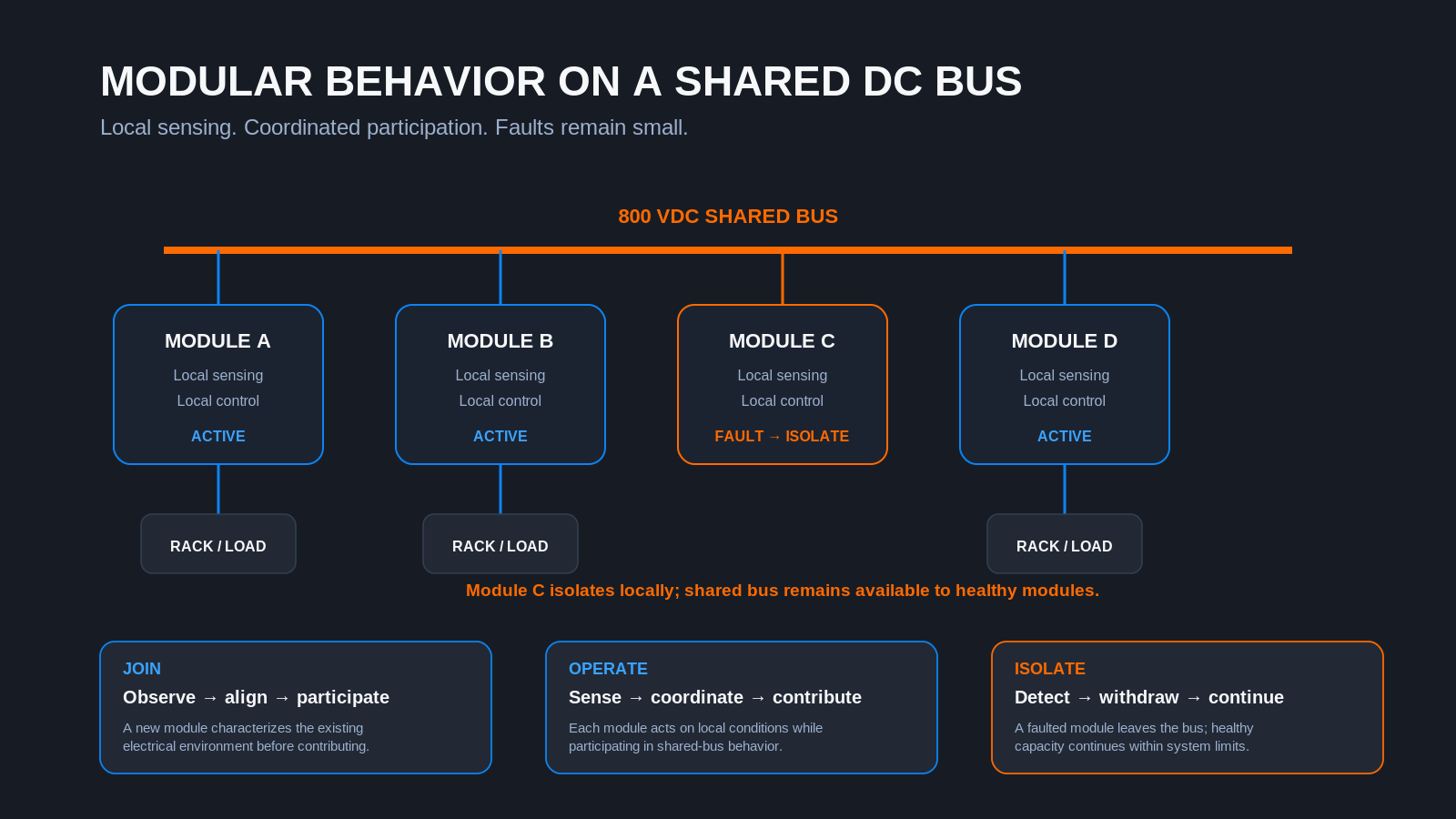
QuietEdge hardware validation is intentionally observer-first. The conventional closed-loop regulator remains authoritative during initial validation. QuietEdge first observes and characterizes system behavior without directly controlling the power stage. Bounded influence is introduced only after review, and protection remains independent.
Modular Behavior
Modular behavior on a shared DC bus
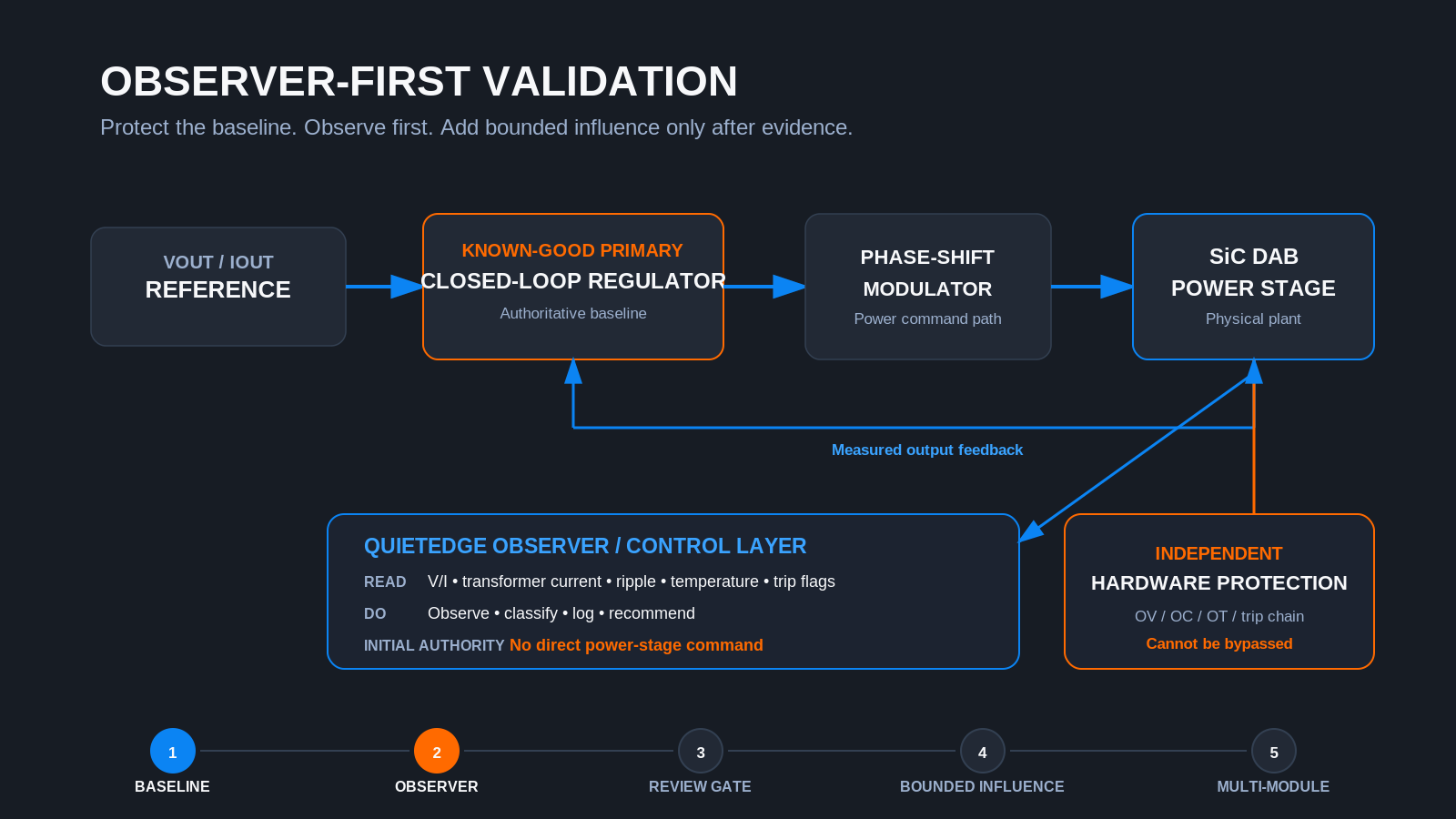
Converter modules on a shared DC bus exhibit three coordinated behaviors. Proprietary handshake details and adaptive algorithms are not disclosed.
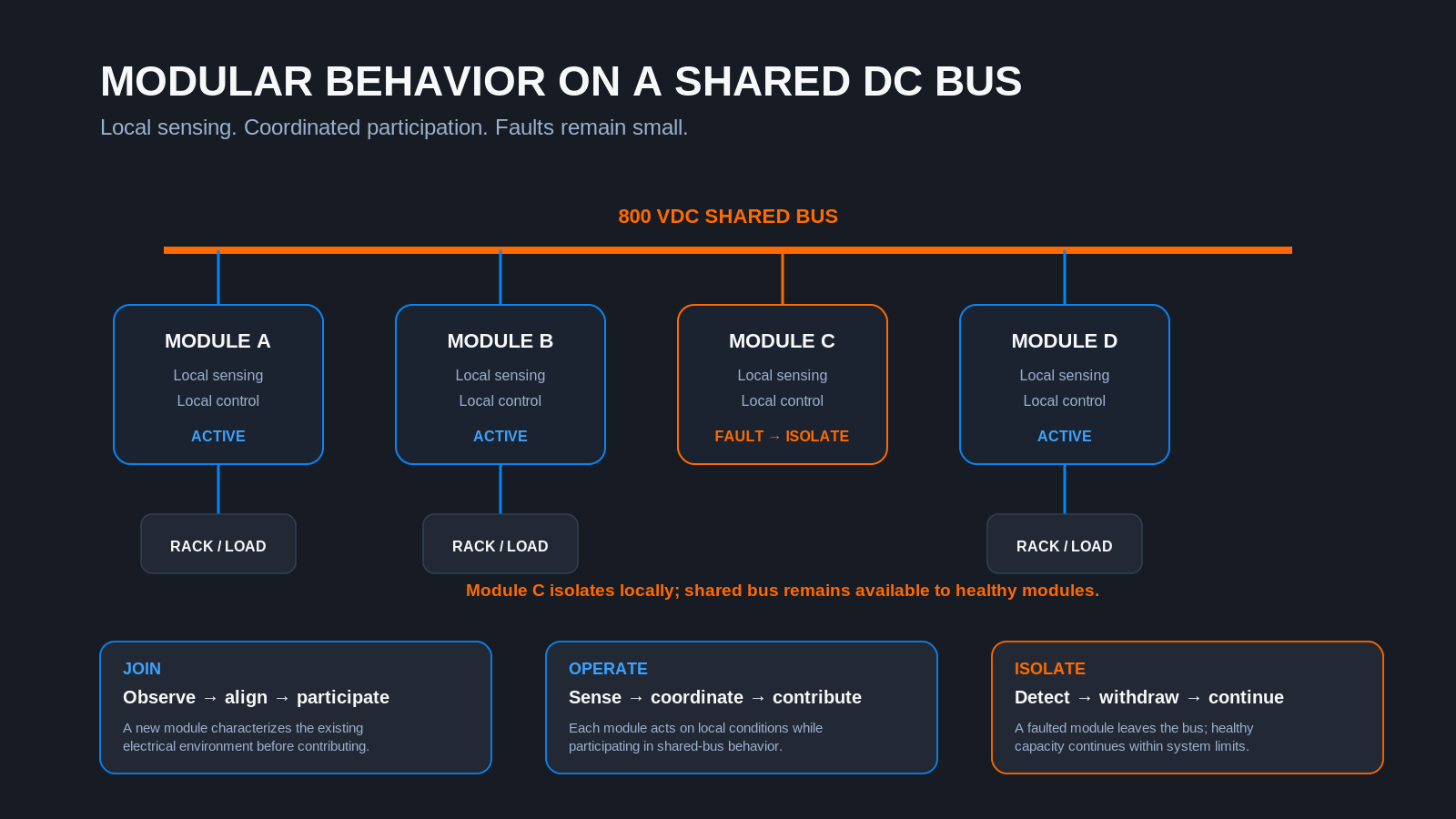
Observe, align and participate. A new module entering the bus characterizes the existing electrical environment before contributing.
Locally sense and coordinate. Each module maintains awareness of its neighbors and adjusts its behavior accordingly — without a central coordinator.
Faults remain local while healthy capacity continues operating. A module that detects an anomaly withdraws without disrupting the shared bus.
Business Model
The behavior is the product
QuietEdge is a control-IP company and is not tied to one power-stage vendor or converter topology. Physical reference systems validate the control behavior. Commercial scale comes through OEM firmware and control-stack licensing, reference architectures, and qualified co-development.
Licensing paths — conceptual
QuietEdge Control IP
OEM Converter
QuietEdge Control IP
SST Platform
QuietEdge Control IP
QuietEdge Reference Architecture
Validation Path
Validation path
Reference Model
Embedded Execution
Single-Module Hardware
Observer Validation
Bounded Influence
Multi-Module Shared Bus
Bring QuietEdge behavior into your platform
QuietEdge welcomes technical discussions with power-electronics OEMs, solid-state transformer developers, silicon partners and data-center infrastructure companies.