
Applications
Built for power systems that change faster than centralized control can react
QuietEdge is developing converter-level control IP for highly dynamic power systems. Our first commercial application is AI data-center rack power, where rapidly changing compute loads, increasing rack density and emerging 800 VDC architectures are changing how power must be distributed and controlled.
AI Data Centers First. A Broader Autonomous-Power Platform Over Time.
Section 01 — AI Data Centers
AI changed more than the amount of power. It changed its behavior.
Traditional data-center infrastructure was largely designed around comparatively predictable loads. Modern GPU clusters can move rapidly between intense compute, communication and reduced-load states, creating steep load ramps and sudden load rejection.
The same average megawatts can therefore be much more difficult to serve when demand is pulsed.
The first response should occur close to the load.
Fast Transients
Rapid changes begin near the compute before slower facility-level systems can fully respond.
Power Density
Higher rack power increases pressure on current, conductors, cooling, protection and conversion stages.
Load Rejection
Sudden reductions in compute demand can propagate upstream unless local power stages contain the transition effectively.
Section 02 — 800 VDC Rack Power
Higher rack power is driving higher distribution voltage
At megawatt-class rack power, low-voltage distribution produces extremely high current. Emerging higher-voltage DC architectures, including 800 VDC-class rack distribution, can substantially reduce current and conductor burden while changing the requirements for conversion, isolation, protection and control.
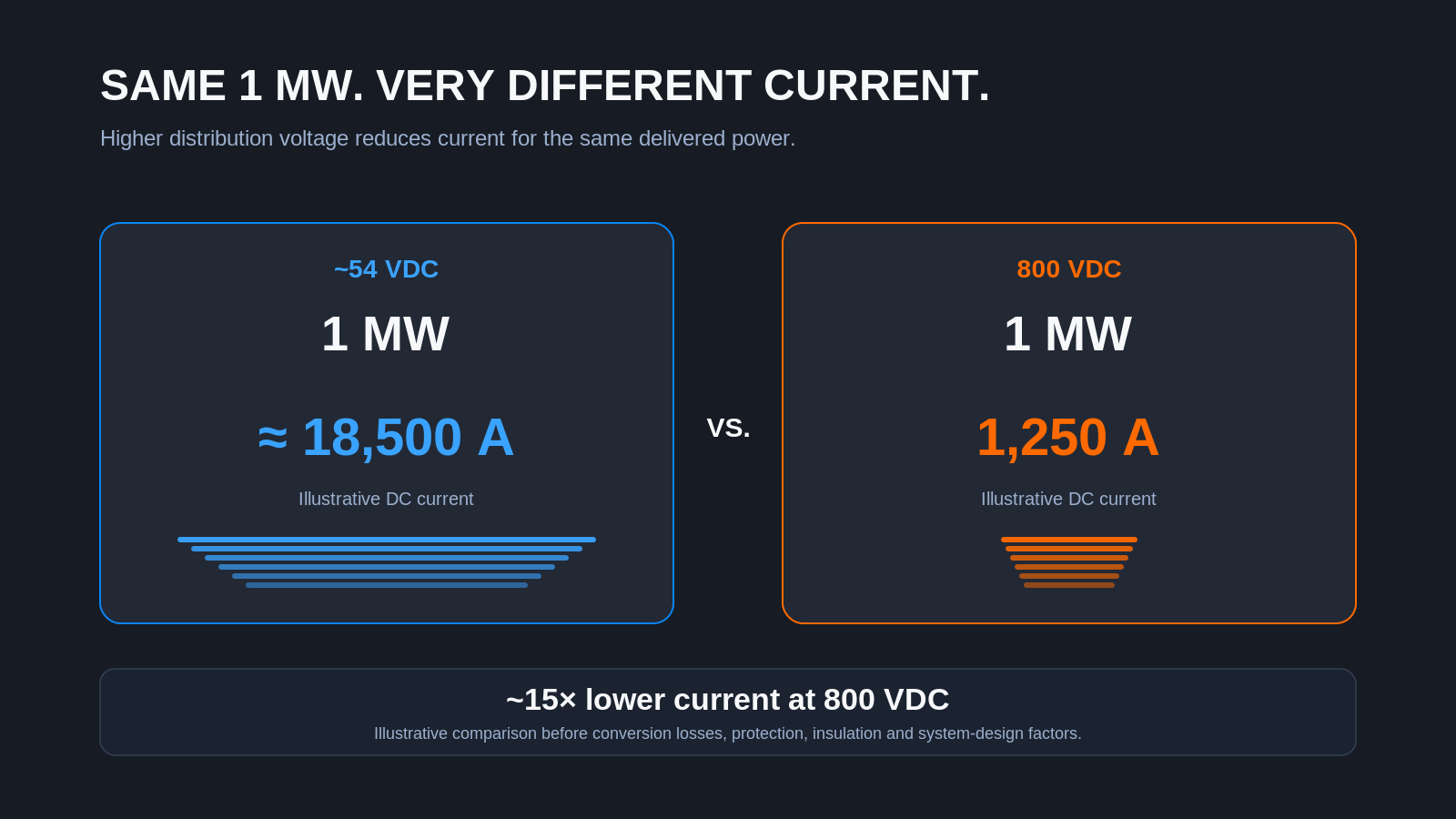
QuietEdge is developing control behavior and reference architectures intended to operate within this evolving high-voltage DC power chain.
Section 03 — What QuietEdge Contributes
A local behavior layer for rack power
Local Response
Converter-level sensing and corrective behavior begin near the electrical event rather than waiting for a supervisory round-trip.
Coordinated Modules
Multiple power modules can coordinate switching and participation while remaining individually observable and fault-contained.
Ripple Management
Distributed interleaving and local observation are intended to reduce aggregate DC-bus disturbances.
Graceful Fault Behavior
Modular architecture favors local isolation and continued operation from remaining healthy capacity where system limits allow.
Central EMS, UPS, BESS and grid systems remain essential. QuietEdge is intended to complement them by addressing the faster local timescale.
Section 04 — Integration Paths
Designed to integrate, not require a complete infrastructure replacement
01
Control / Firmware Licensing
Integrate QuietEdge control behavior into qualified OEM converter hardware.
02
Reference Architecture
Use a QuietEdge-developed DC power architecture as the basis for partner engineering or qualified build-to-print manufacturing.
03
Co-Development
Adapt the controls and reference behavior to a partner's converter, rack-power or system architecture.
Hardware proves the behavior. Integration and licensing scale it.
Adjacent Application
Solid-State Transformers need intelligence below the supervisory layer
SST architectures combine high-frequency conversion, modular power stages and increasingly complex DC distribution. As these systems scale, converter-level observation, coordination and local fault behavior become increasingly important.
QuietEdge control principles may complement SST platforms by providing fast local observation and coordinated behavior inside or downstream of the power-conversion architecture while leaving higher-level supervisory control intact.
Module Coordination
Local power stages coordinate without requiring every fast behavior to originate from a central controller.
Adaptive Observation
Measurement attention increases when the system becomes more dynamic.
OEM Integration
QuietEdge control IP can be evaluated as a layer within partner SST hardware rather than requiring QuietEdge to manufacture the entire transformer platform.
Beyond the Beachhead
Where else could converter-level autonomy matter?
The underlying control problem is not unique to data centers. Other power systems may benefit when loads change rapidly, multiple conversion elements must coordinate, faults should remain local, or supervisory systems operate on a slower timescale.
High-Dynamic DC Systems
Advanced Energy & Mobility
Mission-Critical Power
QuietEdge will expand into adjacent markets only where technical validation and commercial demand support the application.
Does your power system encounter events faster than its central controller can comfortably manage?
QuietEdge is interested in technical discussions with data-center infrastructure companies, power-electronics OEMs, SST developers, semiconductor partners and qualified system integrators.