
Investor Relations
Building the control layer beneath next-generation power infrastructure
AI infrastructure is forcing power systems toward higher density, higher voltage and faster local response. QuietEdge is building the converter-level control IP intended to operate inside that transition.
AI data centers are the beachhead. Control IP is the scalable asset.
The Investment Thesis
Why QuietEdge, why now
AI Power Is Changing Architecturally
AI infrastructure is not only consuming more power. Rapidly changing compute loads and increasing rack density are changing how power must be converted, distributed and controlled.
800 VDC Is Moving Power Closer to the Compute Problem
Emerging higher-voltage rack architectures reduce extreme low-voltage current while increasing the importance of conversion, protection and local control.
The Fastest Control Problem Lives Below the EMS
Facility-level systems remain essential, but converter-level events can occur on much faster timescales. QuietEdge focuses on that local behavior layer.
A Licensing Model Can Scale Beyond One Hardware Product
Physical hardware validates the control behavior. Firmware, control-stack licensing, reference architectures and co-development allow the IP to scale through OEM platforms.
Hardware validates the behavior. Licensing scales it.
What QuietEdge Owns
Protected control architecture, not another commodity power box
QuietEdge's durable value is intended to reside in control behavior and system architecture rather than ownership of every semiconductor, magnetic component or manufacturing process.
Converter-Level Coordination
Local sensing and coordinated behavior close to the electrical event.
Modular Interleaving & Fault Behavior
Multi-module operation designed around coordinated contribution, local fault containment and graceful system behavior.
Adaptive Observation
The system can allocate greater observation attention during changing conditions while remaining bounded from the primary regulation and protection path.
OEM Integration
The control layer is intended to be portable across qualified power hardware and reference architectures.
Core modular DC power architecture and control system are patent pending.
Development & De-Risking
From architecture to physical validation
Current stage: Power hardware validation underway
Architecture & Reference Modeling
Core system behavior established in reference models and simulation.
Patent Protection
U.S. nonprovisional utility application filed for the core modular DC power architecture and control system.
Embedded Execution
Control software progressed into target-class real-time processing environments.
Single-Module Power Hardware
CurrentStaged SiC dual-active-bridge validation underway.
Observer Validation
QuietEdge is introduced first as an observer beside a known-good primary regulator.
Bounded Influence & Multi-Module Validation
Next stages progress toward controlled influence and shared-bus multi-module testing.
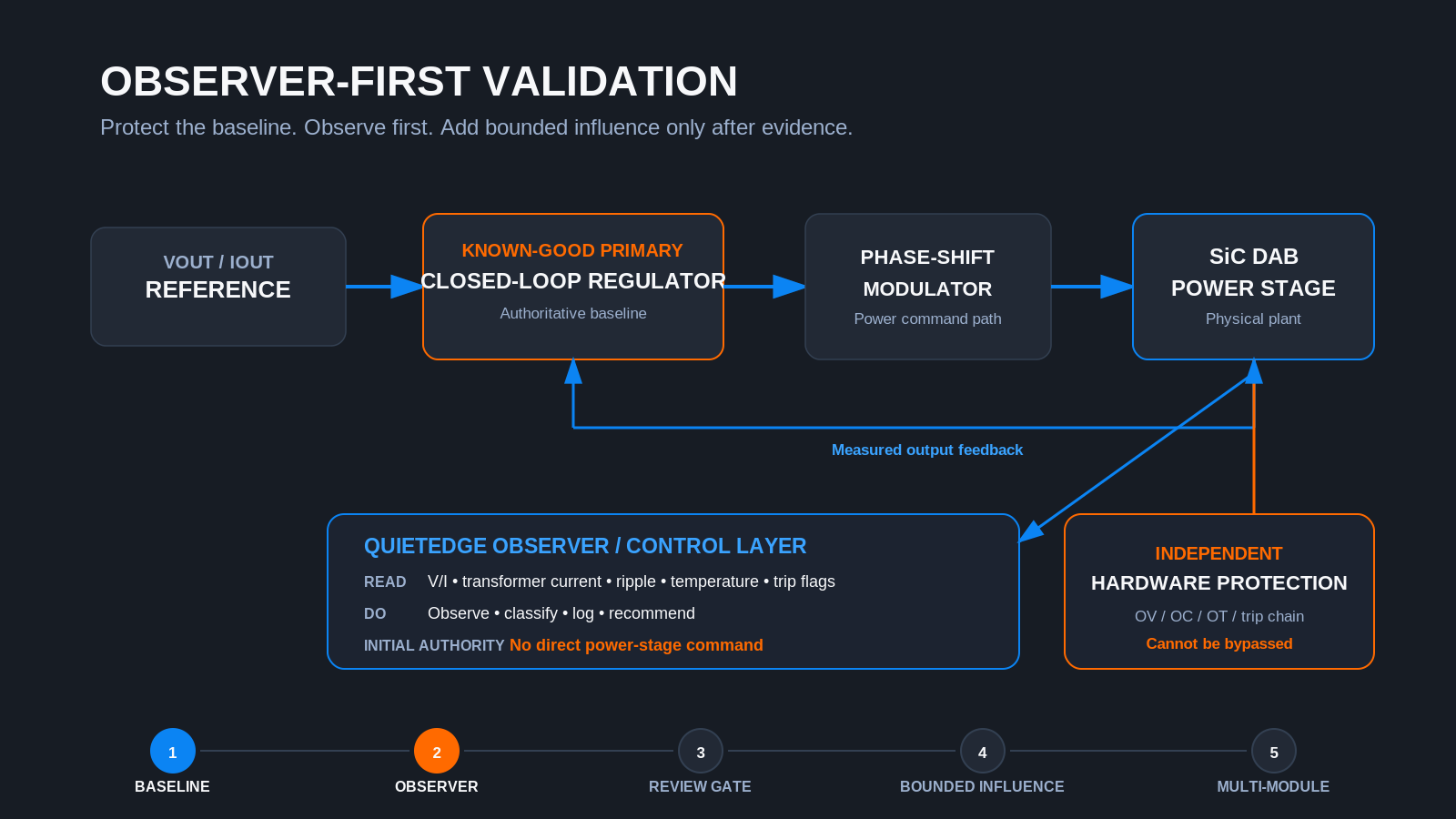
Validation Strategy
The validation strategy is deliberately staged: prove the baseline, observe without disturbing it, introduce bounded influence only after review, then scale to multiple modules.
Ecosystem Milestone
QuietEdge was selected for the Electrify Nevada Fall 2026 Reno-Tahoe cohort, expanding the company's access to Nevada's energy, university, investor, and industrial ecosystem.
Business Model
A capital-efficient path from proof to scale
01
Control & Firmware Licensing
License QuietEdge behavior into qualified OEM power-conversion platforms.
02
Reference Architecture
Provide system architecture and build-to-print foundations for qualified manufacturing and integration partners.
03
Co-Development
Adapt QuietEdge controls and architecture to strategic partner platforms and applications.
QuietEdge intends to retain the core behavioral IP while leveraging specialized semiconductor, engineering, manufacturing and OEM partners for scale.
Market Entry
A focused beachhead with broader platform potential
First Market
AI Data-Center Rack Power
High-density compute, fast transient behavior and emerging 800 VDC architectures provide an immediate environment in which converter-level control can create measurable value.
Adjacent
Solid-State Transformers
Modular high-frequency conversion platforms provide another natural environment for local observation, coordination and OEM-integrated control IP.
Longer Term
Other High-Dynamic Power Systems
QuietEdge may expand into other applications only where technical evidence and customer demand justify the move.
What Capital Accelerates
Capital converts technical risk into commercial proof
Hardware Validation
Complete staged single-module and multi-module electrical validation.
Engineering Team
Expand power electronics, firmware/DSP, controls, thermal and integration capability.
Reference Hardware
Build repeatable demonstrators and partner-ready reference architectures.
Commercial & Certification Path
Advance OEM integration, customer pilots, manufacturing readiness and required compliance work.
Detailed use of funds and financial projections are available to qualified investors.
Team
Power architecture plus commercialization
John Springer
Founder & Chief Architect
Inventor and systems architect. Power electronics, DC architectures, microgrids and control systems.
Chris Larsen
Co-Founder & CEO
25+ years in power-electronics commercialization, strategic partnerships and go-to-market execution.
Matt Lugar
Executive Advisor
30+ years in clean-energy finance, capital formation and data-center infrastructure.
Cy MacKinnon
Strategic Advisor
25+ years in infrastructure investment across energy, real assets, utilities and institutional capital.
Investor Access
Request investor materials
QuietEdge maintains additional business, technical and diligence materials for qualified prospective investors.
Public Disclosure Note
A note on technical claims
QuietEdge publicly distinguishes between modeled or simulated results, embedded measurements, physical hardware validation and future engineering targets. Detailed validation data are made available where appropriate.
Evidence before claims.
Interested in the next layer of AI power infrastructure?
We welcome conversations with investors who understand deep technology, power electronics, infrastructure and the time required to convert protected engineering IP into durable commercial systems.